
Practical guide · Dubai
Paid a rental deposit, but the Dubai apartment is blocked for unpaid service charges. What next?
Find out exactly what is blocked, ask the landlord to resolve it in writing, and protect the money already paid. An Ejari registration block, a refused move-in permit and denied physical access need different responses. Paying the landlord's bill yourself is not the automatic next step.
This guide is for tenants renting a Dubai home, not buying one. It covers ordinary residential tenancies within the Rental Disputes Center's jurisdiction. DIFC properties and holiday-home bookings need separate checks.
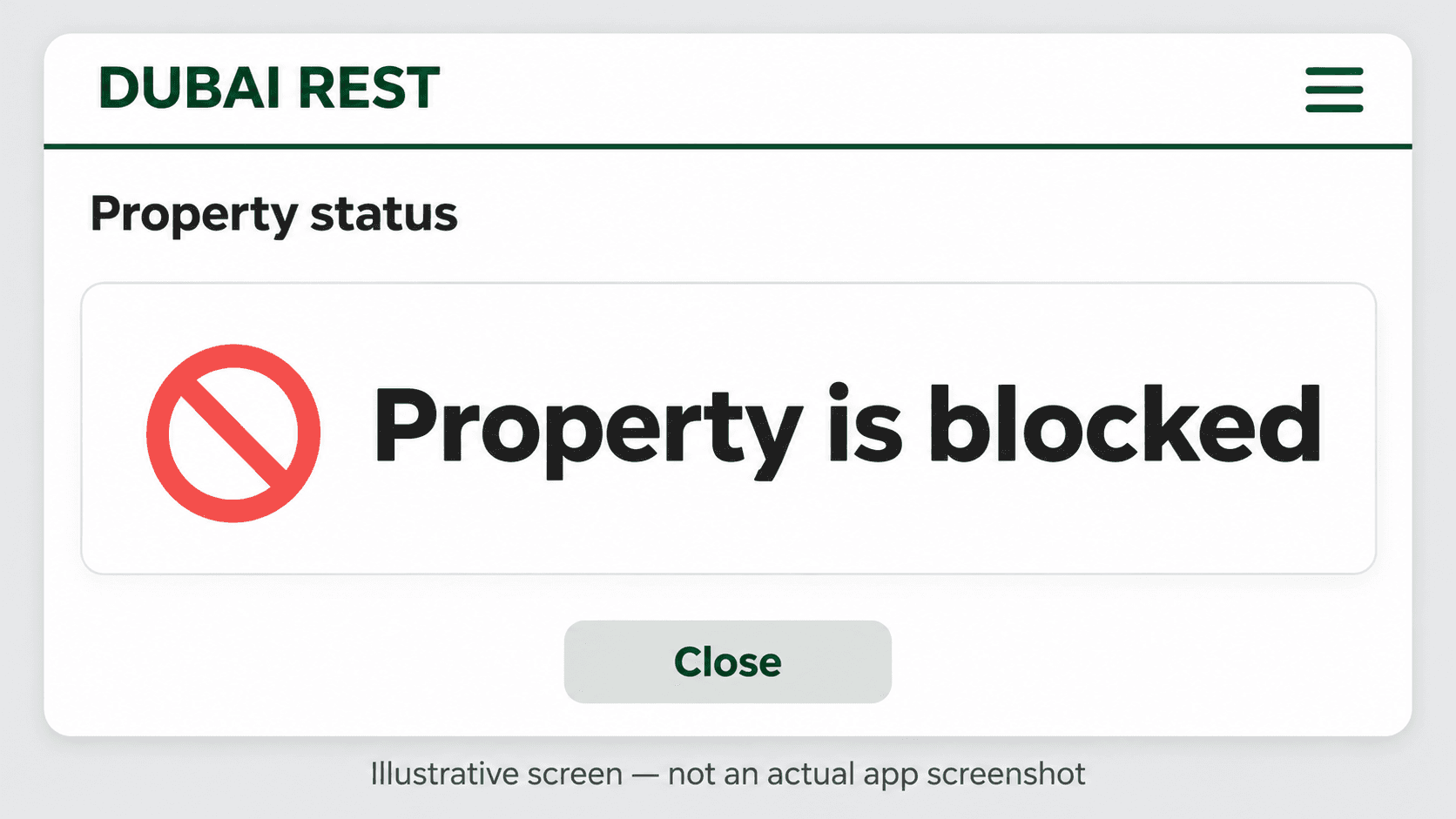
What does "the apartment is blocked" actually mean?
Ask for the rejection message and its reason. Ejari is Dubai's tenancy-registration system. DLD's official FAQ expressly recognises properties blocked in Ejari because of unpaid service charges. It directs the property holder to the management company or the Rental Disputes Center, usually called RDC.
But the problem could instead be a building move-in approval, an access card, or a restriction from another authority. Ask who placed it, what it prevents and what is required to remove it. A verbal "DLD block" is not enough to identify the procedure.
Who must deal with the unpaid service charges?
Start with the landlord. Article 25 of Dubai Law No. 6 of 2019 places the service-charge obligation on the property holder. Your rental deposit does not, by itself, make their old arrears your debt. Check any clause that separately allocates costs between you and the landlord.
Ask the landlord to obtain the dated balance, arrange clearance and provide evidence that registration or move-in can proceed. Deal with the actual management company, even if everyone calls it the "owners association".
What should I do as soon as I discover the block?
Build a written record before agreeing to another payment or a new date.
- Save the lease or booking terms, deposit receipt, payment proof and promised move-in date.
- Get the rejection or refusal in writing, with its reference and reason.
- Ask the landlord for the clearance plan and a written handover date; copy the agent if one is involved.
- List any cheques already handed over, their dates and who holds them. Separate rent, security deposit and agency fees.
- Confirm registration, required building approvals and access before rearranging movers.
Do not simply stop a cheque or deduct rent yourself. If a payment is due while the issue remains unresolved, obtain advice on the correct procedure. Keep private documents and property identifiers out of public posts.
Can the landlord or agent use my deposit to clear the arrears?
Do not assume that this is authorised. First establish whether it is a security deposit, booking payment or advance rent, and whether it is still held or has been released.
Article 20 of the tenancy law addresses a security deposit for the property's condition at the end of the tenancy. It is not blanket permission to redirect money held by an agent to an old bill.
Ask the holder to confirm the receipt terms and release instructions. Request that the money remain held while the problem is clarified, but do not assume that your request alone changes an existing agreement.
Should I pay the charges myself and deduct them from rent?
The first option should be for the landlord to clear them. If you consider another arrangement, get legal advice and written agreement covering the exact bill, verified payment account, rent credit, clearance steps and repayment if move-in still fails. Confirm the arrangement with management before paying.
Fictional example: a rent instalment is AED 20,000. The landlord asks the tenant to pay AED 8,000 towards old charges. Only under an agreed arrangement would the remaining instalment be AED 20,000 - AED 8,000 = AED 12,000. The total remains AED 20,000. A separate AED 5,000 security deposit is not counted again. These are assumed amounts, not standard charges or an approved payment scheme.
Can I cancel and get my deposit back?
You can request cancellation and repayment; the outcome depends on the agreement and facts. A booking payment before a lease is concluded needs its own review. Where a valid lease exists, Article 7 restricts unilateral termination. The amended Article 15 requires the landlord to hand over the property in a condition allowing its agreed use.
Seek either a written solution with an agreed start date and treatment of the delay, or a written termination and repayment agreement. If agreement fails, ask a property lawyer about the appropriate claim. Do not assume either "all deposits are non-refundable" or "a block guarantees an immediate refund".
Fictional example: the tenant paid a deposit of AED 5,000 and advance rent of AED 15,000. The amount paid is AED 5,000 + AED 15,000 = AED 20,000. Identify each payment and recipient in the refund request. This calculation records money paid; it does not decide what a court will award.
What if the deposit went to the agent?
Ask who currently holds it and under whose authority. Obtain written confirmation of any onward transfer and distinguish the deposit from a separately agreed agency fee. The right claim depends on who received the money, the agreement and the alleged failure.
DLD's real-estate-company complaint service addresses regulatory violations. Its terms exclude rental disputes and requests for contract cancellation, refunds or compensation. A complaint about an agent is therefore not a substitute for the correct money-recovery claim.
Can I approach RDC when Ejari cannot be issued?
Explain the missing registration rather than assuming you have no route. RDC's official FAQ says a rental claim without a rental contract can be registered with a request to establish the tenancy relationship. That does not mean every reservation payment proves a tenancy.
Show the signed lease, correspondence, receipts and rejection evidence to an RDC service centre. Ask which registration steps and requests apply. If no tenancy was concluded, have the appropriate claim and forum checked before filing.
The rental claim service lists identification, bank-account details and supporting evidence; documents must be in Arabic or legally translated into Arabic. Submit these privately through the official process.
Which route should I use to resolve the problem?
Match the route to the result you need.
- Clear the service-charge registration block: the landlord follows up with management or RDC, as described in the DLD FAQ. Obtain confirmation that the block is actually removed.
- Agree a rental settlement: RDC offers conciliation. A settlement signed and approved through that process can be enforced at RDC.
- Seek a disputed rental remedy: use the appropriate RDC rental claim, after confirming the requests and parties.
A service-charge payment receipt alone does not confirm that every restriction has been cleared. DLD describes a different release-and-support-ticket process for blocks originating from courts, police or Dubai Municipality.
What if management refuses access or disconnects services?
Treat this separately from an Ejari system error. Do not force entry. Article 29 of Law No. 6 of 2019 limits improper restrictions on the property holder's use as a debt-collection tactic; it should not be presented as an automatic tenant move-in approval.
For a tenancy, RDC's petition-order service covers temporary requests such as restoring utilities or activating building and parking access cards. Ask which request and evidence fit your circumstances, especially if the tenancy is not yet registered.
Official Article 34 guidance also explains documenting landlord interference through the competent police station. That is not the routine procedure for every registration block.
Can I claim hotel, storage or moving costs?
Keep evidence and assess the claim; reimbursement is not automatic. Record the agreed handover date, why you could not move in, efforts to resolve the issue and reasonably incurred extra expenses. A lawyer can assess the contractual and legal basis and what must be proved.
Fictional example: three extra hotel nights at AED 350 cost 3 x AED 350 = AED 1,050. Add AED 300 of storage, giving AED 1,350 in documented extra expenses. These assumed costs are separate from the deposit and rent. Receipts show expenditure, not a guaranteed compensation award.
What can I write to the landlord now?
Use a clear written request. Adapt this to the facts:
"I paid the rental deposit and was due to move in on the agreed date. I have now been told that unpaid service charges are blocking registration or move-in. Please confirm the exact restriction, who will resolve it and the proposed clearance and handover dates. Please also confirm where my deposit is held. If handover cannot proceed as agreed, please propose a written termination and repayment arrangement."
This is a practical message, not a substitute for any formal notice your claim requires.
Related reading: For the narrower access-card issue, read missing access cards at move-in. For a deposit dispute at the end of a tenancy, see landlord not returning your deposit. If you already have a judgment, see enforcing a rental judgment.
Official sources checked: 16 November 2026. General information for Dubai tenants; contracts, restrictions and available remedies require individual assessment.